HOME

Periodic Tables

Advanced History of the Periodic Table of the Elements


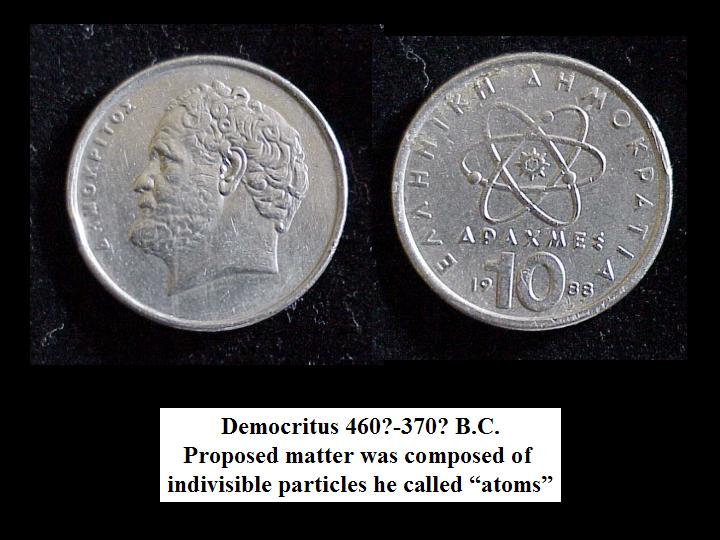
Democritus coin. Caption: Democritus 460?-370?BC proposed matter was composed of indivisible particles he called "atoms"


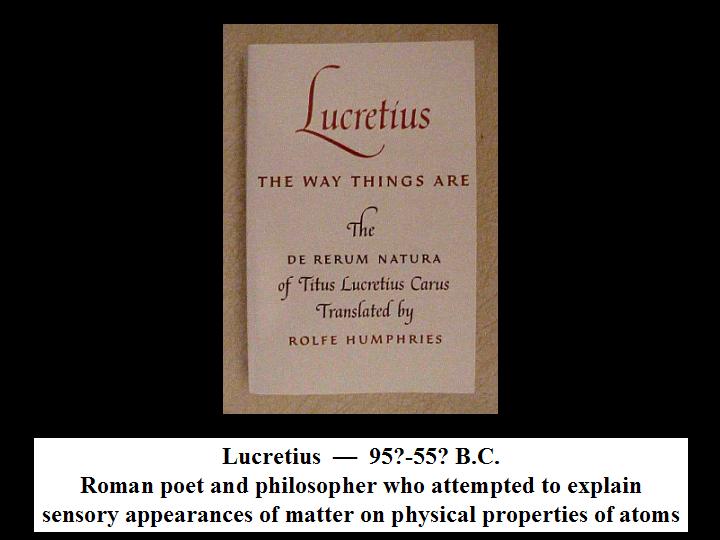
Lucretius book.  Caption: Lucretius 95?-55?BC - Roman poet and philosopher who attempted to explain sensory appearances of matter on properties of atoms


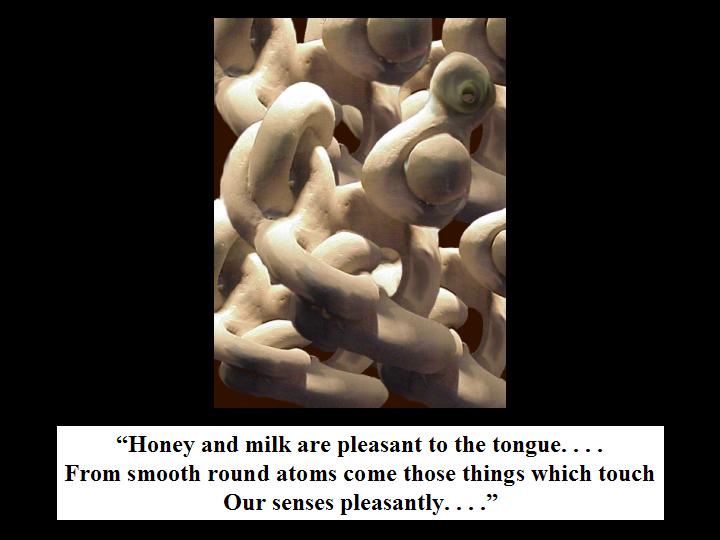
Smooth wooden carvings.  Caption: "Honey and milk are pleasant to the tongue... . From smooth round atoms come those things which touch our senses pleasantly... ."


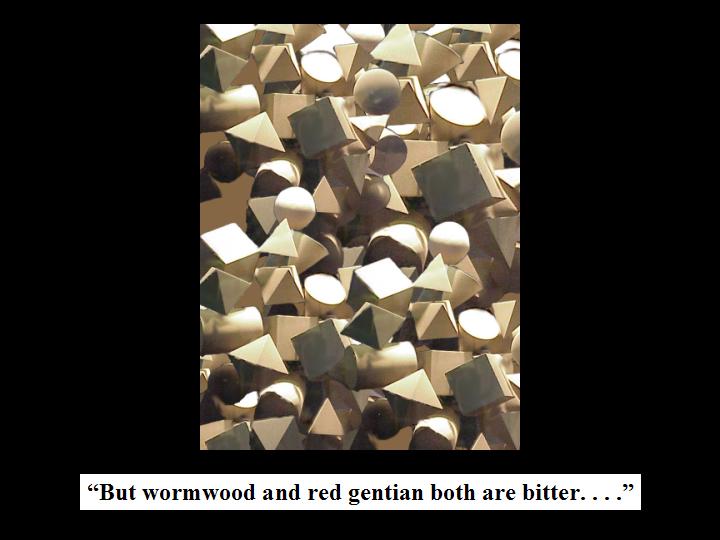
Triangle and square wooden carvings.  Caption: "But wormwood and red gentian both are bitter... ."


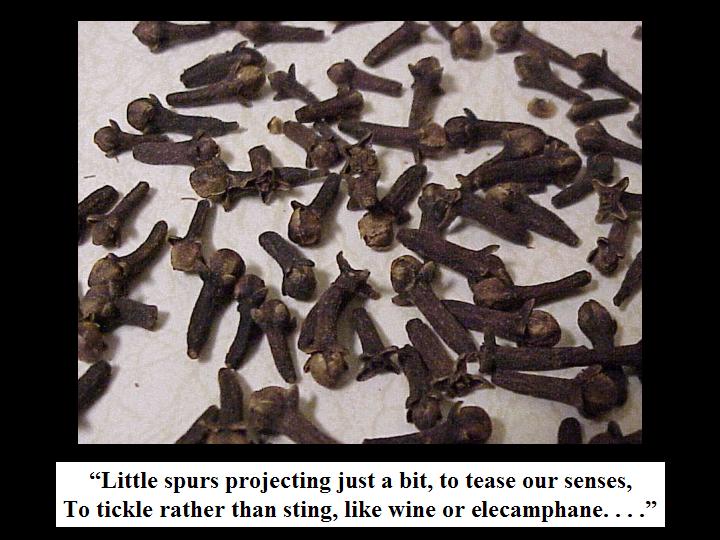
Close-up of cloves.  Caption: "Little spurs projecting just a bit, to tease our senses.  To tickle rather than sting, like wine or elecamphane... ."


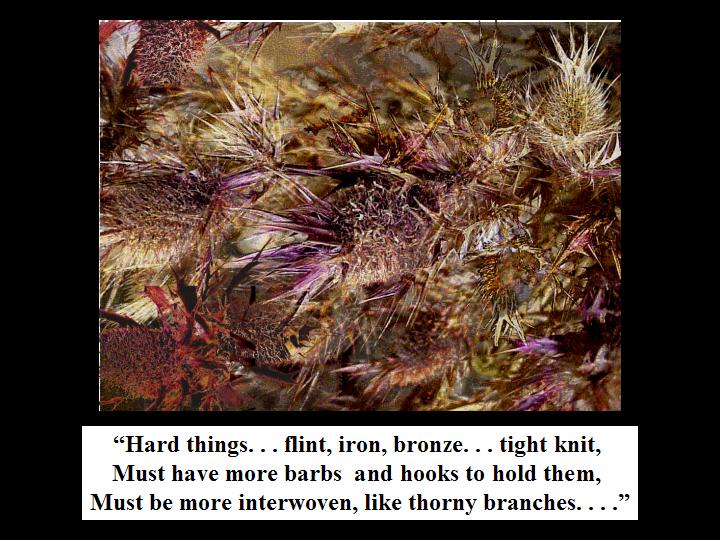
Close-up of thistles.  Caption: "Hard things... flint, iron, bronze... tight knit, must have more barbs and hooks to hold them. Must be more interwoven, like thorny branches... ."


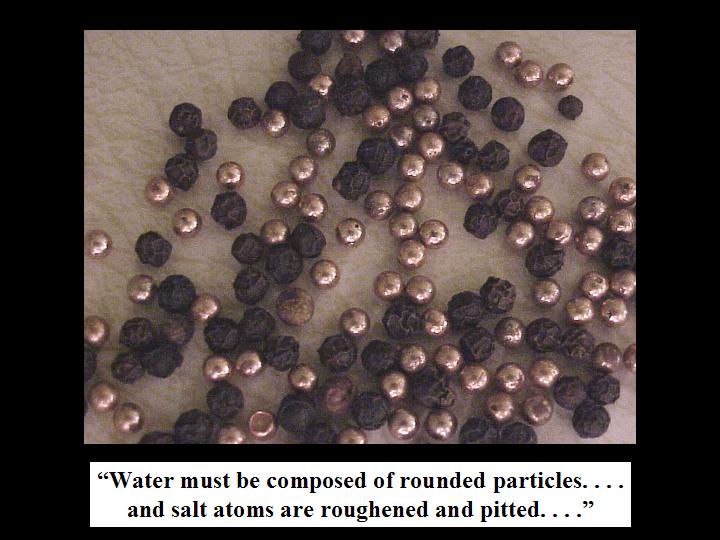
Mixture of bbs and peppercorns. Caption: "Water must be composed of rounded particles... . And salt atoms are roughened and pitted... ."


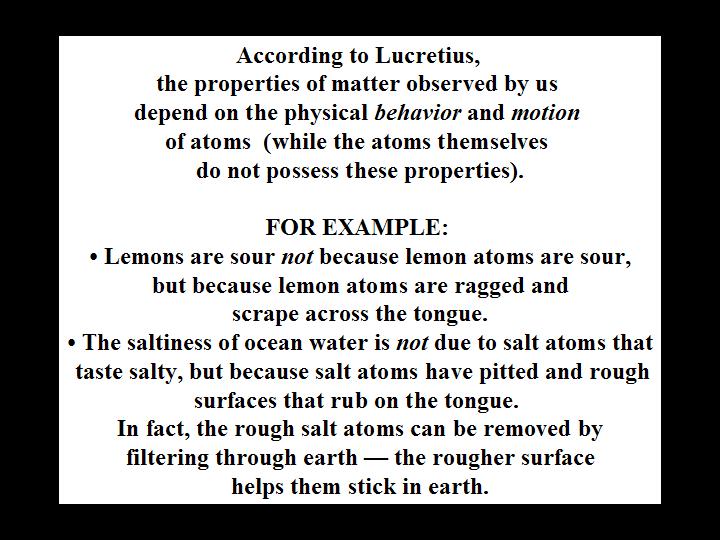
According to Lucretius, the properties of matter observed by us depend on the physical behavior and motion of atoms  (while the atoms themselves do not possess these properties). FOR EXAMPLE: Lemons are sour not because lemon atoms are sour, but because lemon atoms are ragged and scrape across the tongue. The saltiness of ocean water is not due to salt atoms that taste salty, but because salt atoms have pitted and rough surfaces that rub on the tongue. In fact, the rough salt atoms can be removed by filtering through earth — the rougher surface helps them stick in earth.


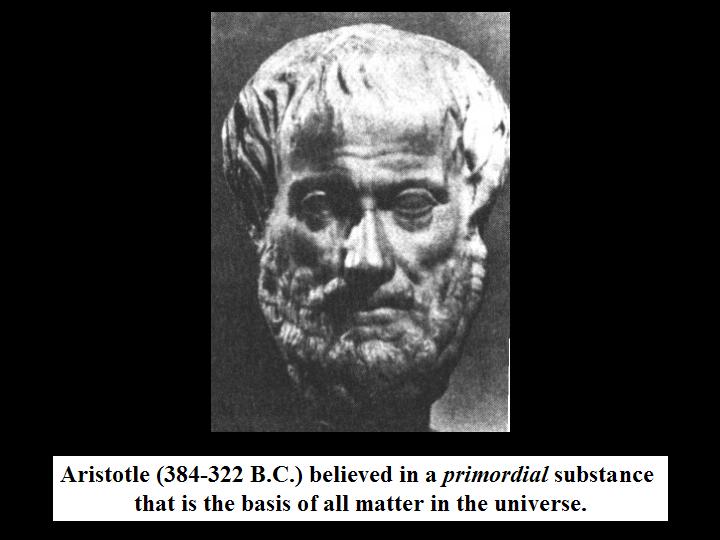
Bust of Aristotle.  Caption: Aristotle 384-322BC believed in a primordial substance that is the basis of all matter in the universe.


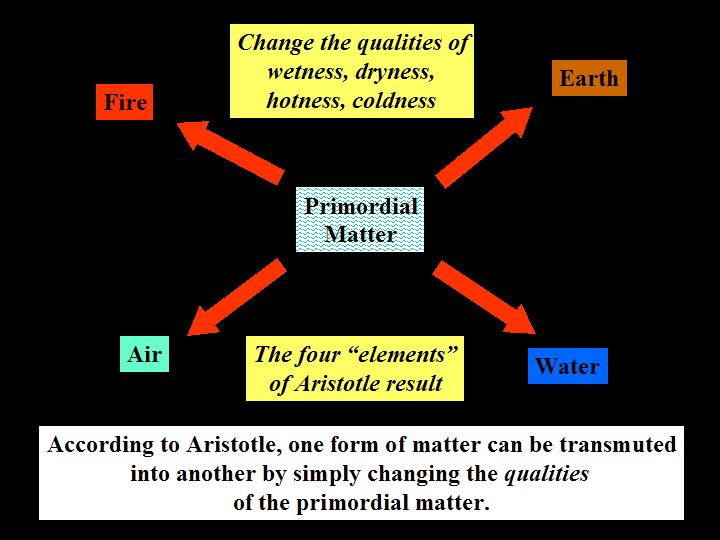
A chart of Aristotle's transmutation idea.  Caption: According to Aristotle, one form of matter can be transmuted into another by simply changing the qualities of the primordial matter.


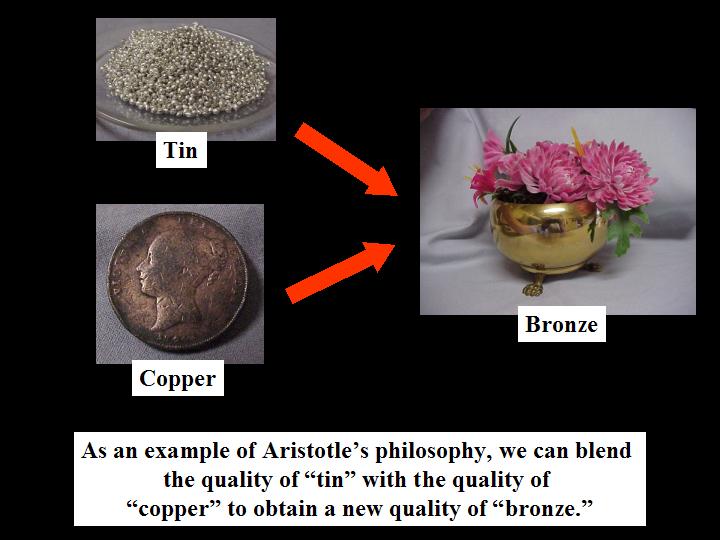
Tin + copper = bronze.  Caption: As an example of Aristotle's philosophy, we can blend 
the quality of "tin" with the quality of 
"copper" to obtain a new quality of "bronze."


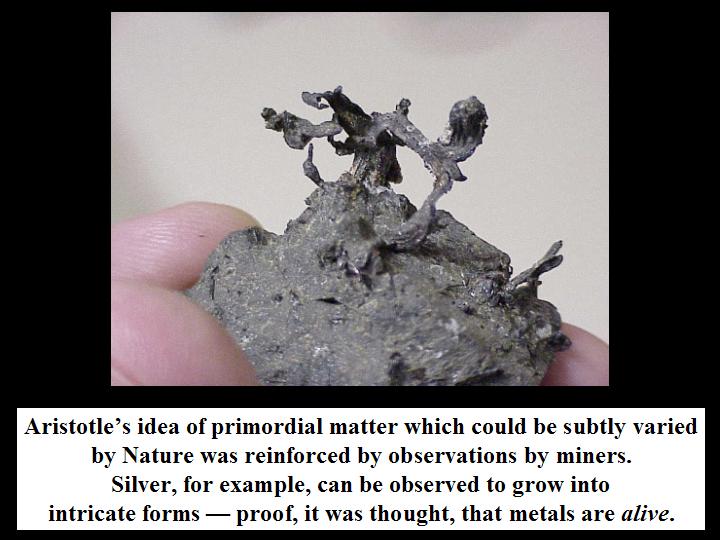
A rock sample with tendrils coming out of it.  Caption: Aristotle's idea of primordial matter which could be subtly varied by Nature was reinforced by observations by miners. Silver, for example, can be observed to grow into
intricate forms — proof, it was thought, that metals are alive.


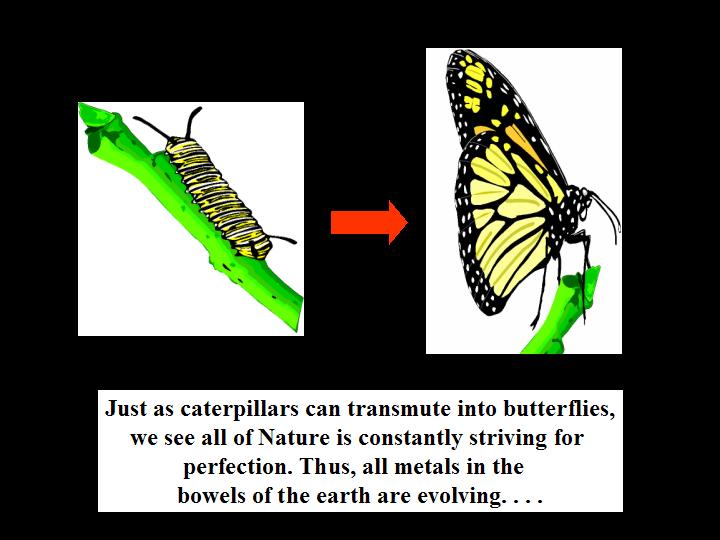
Caterpillar becomes butterfly.  Caption: Just as caterpillars can transmute into butterflies,
we see all of Nature is constantly striving for 
perfection. Thus, all metals in the  
bowels of the earth are evolving. . . .


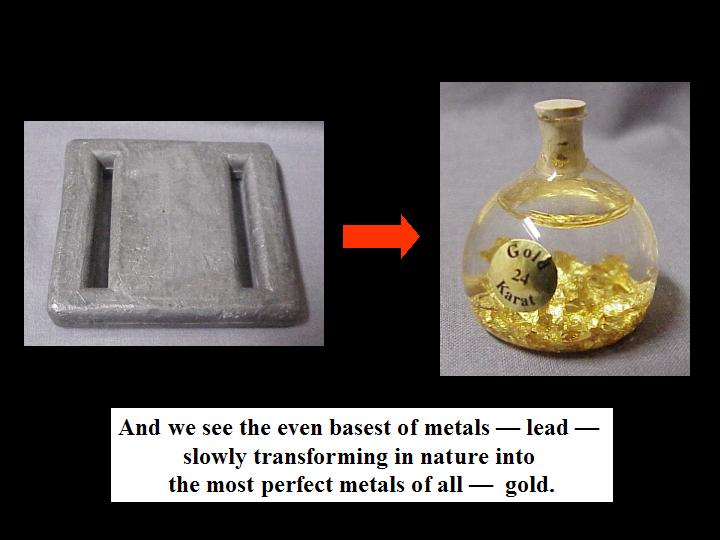
Lead weight becomes (?) gold.  Caption: And we see the even basest of metals — lead — 
slowly transforming in nature into 
the most perfect metals of all —  gold.


The contribution of Democritus and Lucretius was the 
concept that matter is composed of tiny particles
which may look very strange indeed and
whose behavior on an atomic scale determined how
the matter was perceived and sensed by us.

The contribution of Aristotle was the idea of primordial matter.
This concept laid the foundation for the dreams of alchemists
who aspired to duplicate Nature and transmute base metals into 
gold, thereby discovering thousands of new chemicals. 
After the true "immutable" elements were discovered (Lavoisier, 
1789), Aristotle’s idea led, in the twentieth century, to the
discovery of the "primordial matter" of protons, electrons, 
and neutrons and to the realization 
that elements were not really immutable after all.


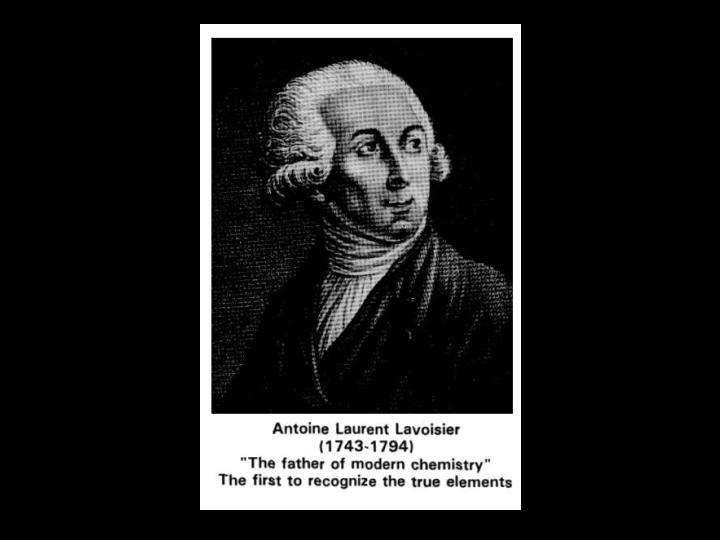
Antoine Laurent Lavoisier 1743-1794


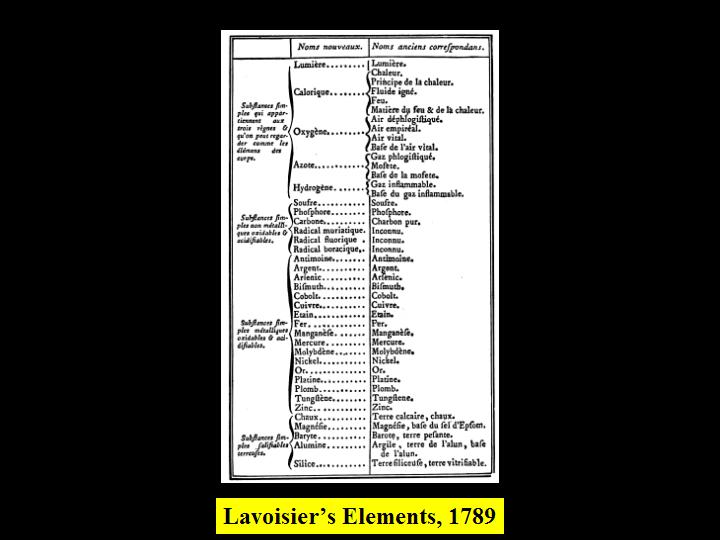
Table of Lavoisier's Elements, 1789


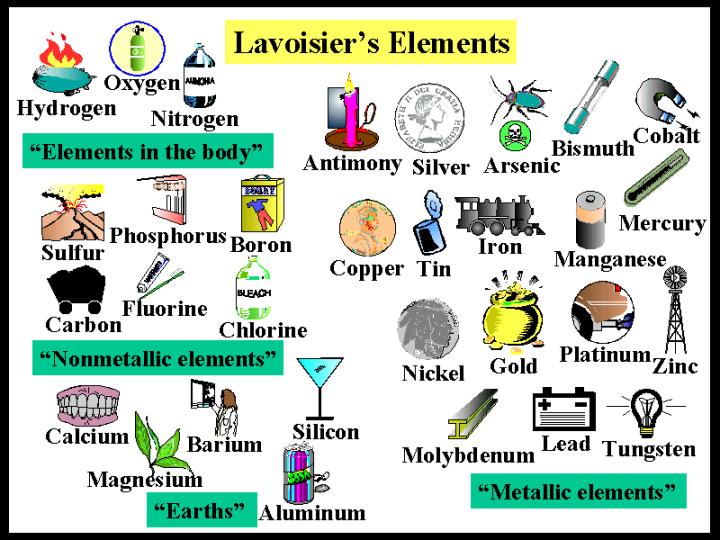
The elements that Lavoisier knew at the time: elements of the body (hydrogen, oxygen, nitrogen), nonmetallic elements (sulfur, phosphorous, boron, carbon, fluorine, chlorine), earths (calcium, barium, silicon, magnesium, aluminum), metallic elements (antimony, silver, arsenic, bismuth, cobalt, copper, tin, iron, manganese, mercury, nickel, gold, platinum, zinc, molybdenum, lead, tungsten)


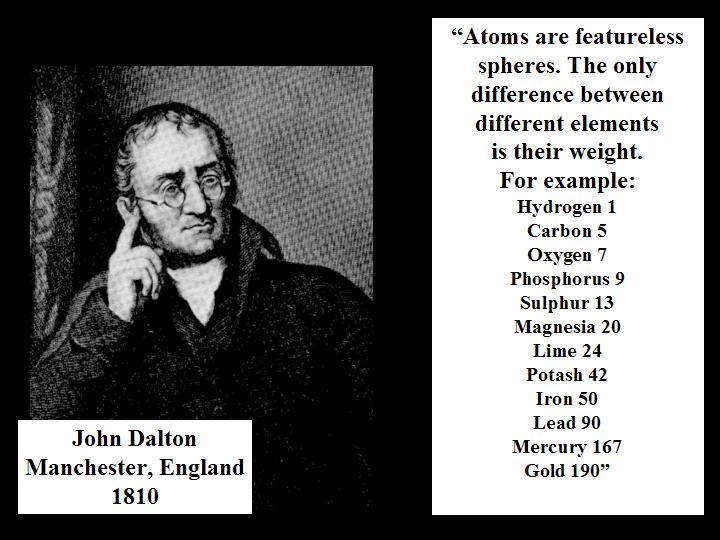
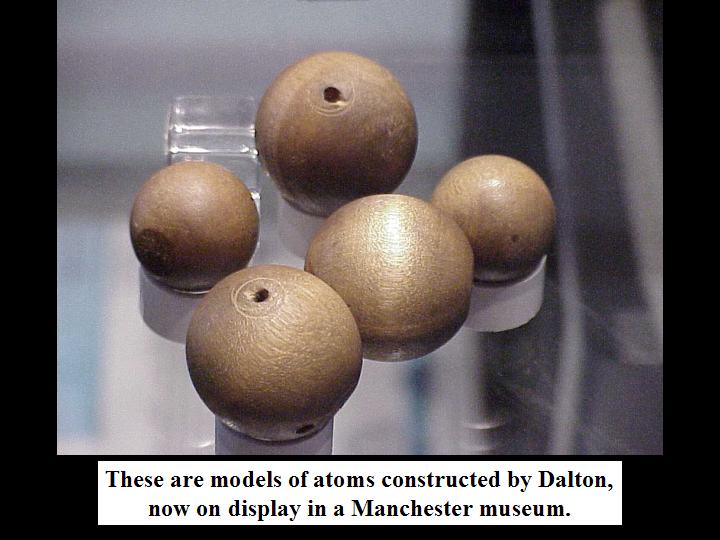
Portrait of John Dalton.  Caption: John Dalton, 1810, postulated that atoms are featureless spheres that only differed in weight (e.g. Hydrogen 1; Carbon 5; Oxygen 7; etc).


Models of atoms constructed by Dalton, which are wooden balls of different sizes, on display at the Manchester Museum


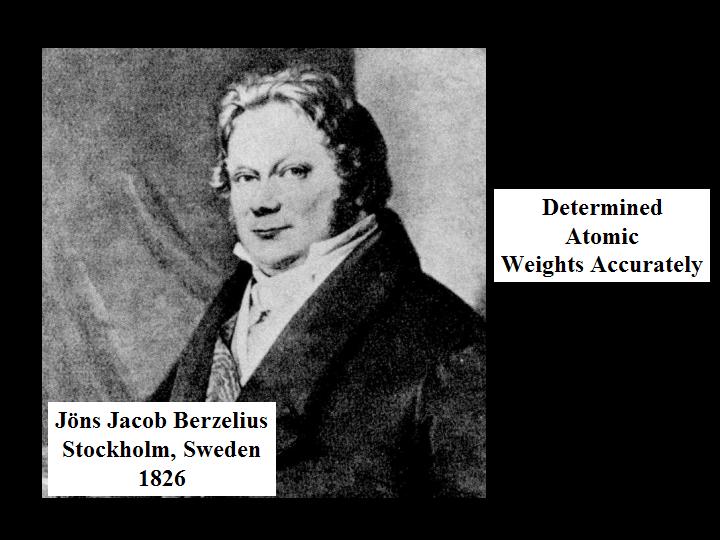
Portrait of Berzelius.  Caption: Berzelius, 1826, determined atomic weights accurately.


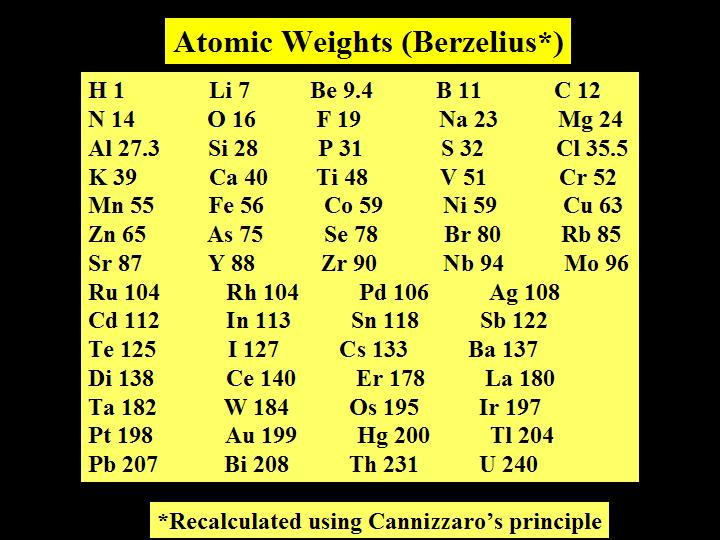
Table of atomic weights by Berzelius recalculated using Cannizzaro's principle are generally correct


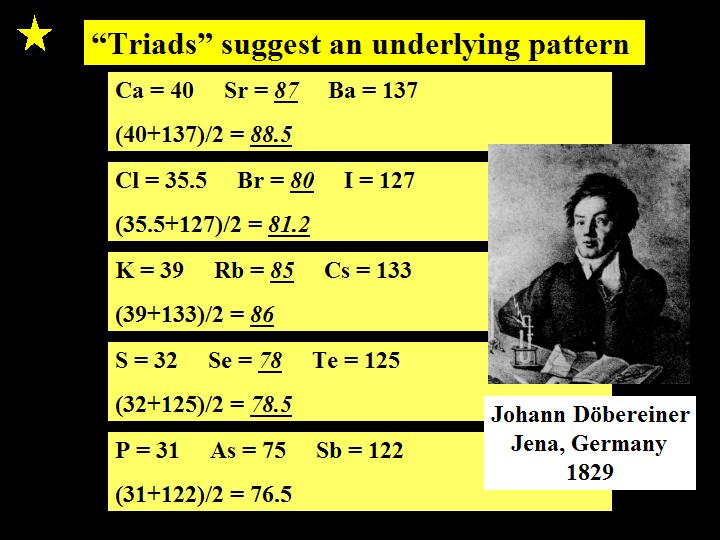
Portrait of Döbereiner and mathematical formulas.  Caption: Döbereiner - triads suggest an underlying pattern, 1829


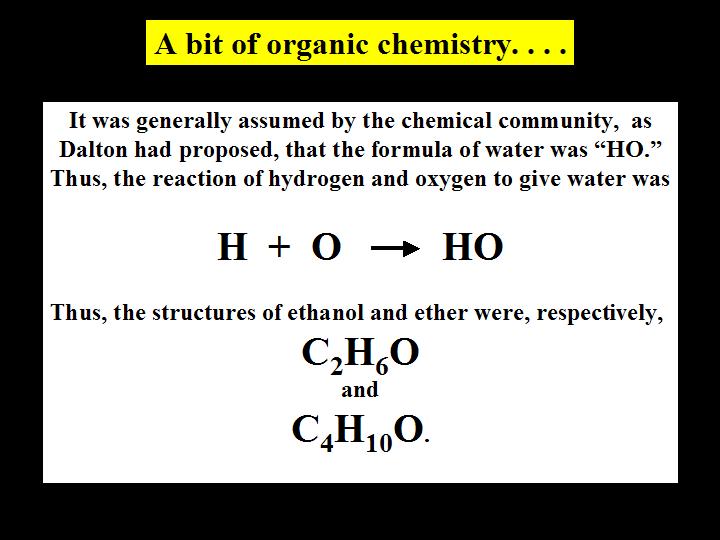
A bit of organic chemistry... . It was generally assumed by the chemical community,  as Dalton had proposed, that the formula of water was "HO."
Thus, the reaction of hydrogen and oxygen to give water was

H  +  O = HO.

Thus, the structures of ethanol and ether were, respectively,
C2H6O 
and
C4H10O.


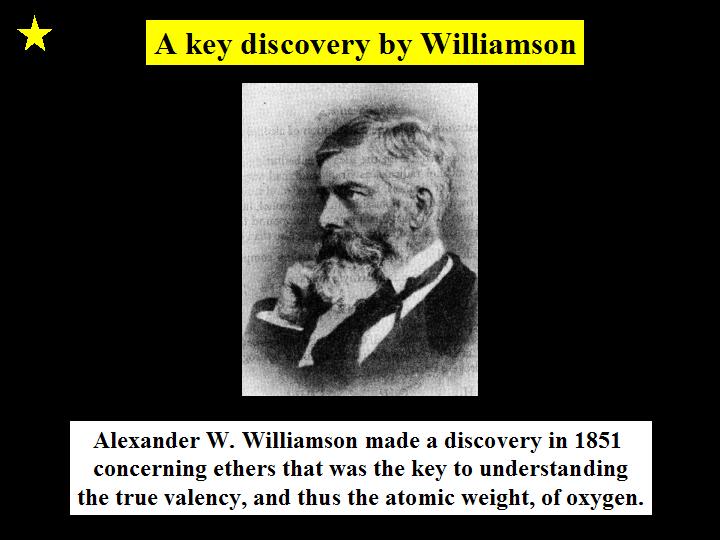
Portrait of Williamson.  Williamson in 1851 made a discovery concerning ethers that was key to understanding the true valency, and thus the atomic weight, of oxygen.


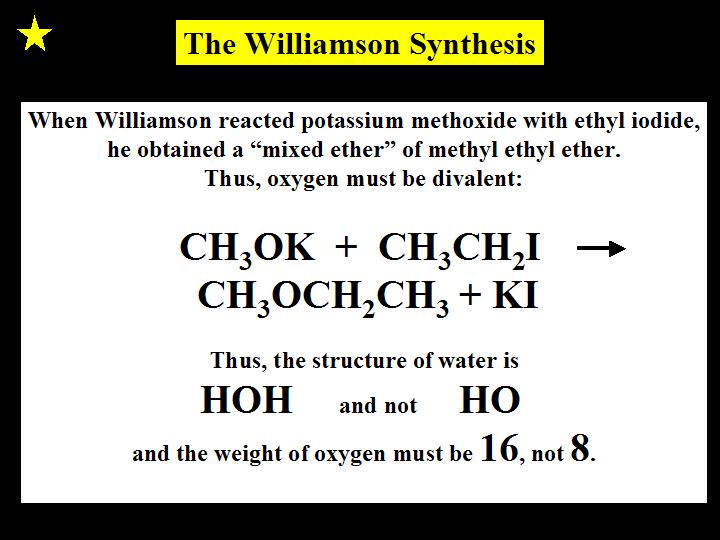
The Williamson Synthesis: When Williamson reacted potassium methoxide with ethyl iodide,
he obtained a "mixed ether" of methyl ethyl ether.
Thus, oxygen must be divalent:

CH3OK  +  CH3CH2I =
   CH3OCH2CH3 + KI

Thus, the structure of water is
HOH     and not       HO 
and the weight of oxygen must be 16, not 8.


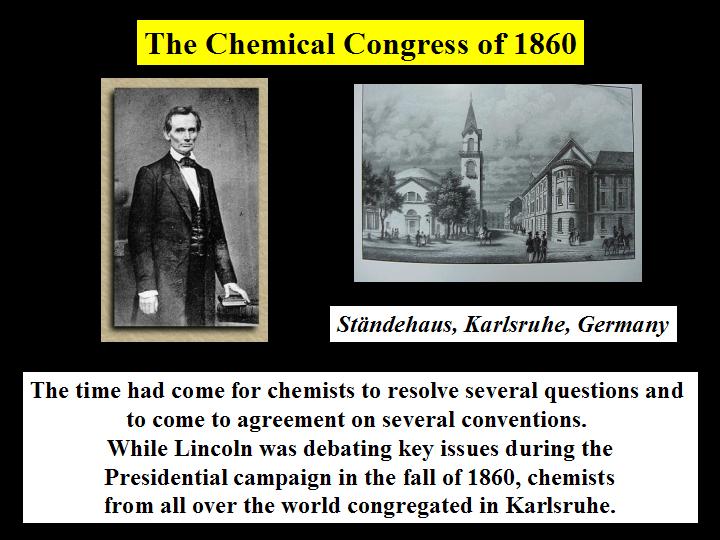
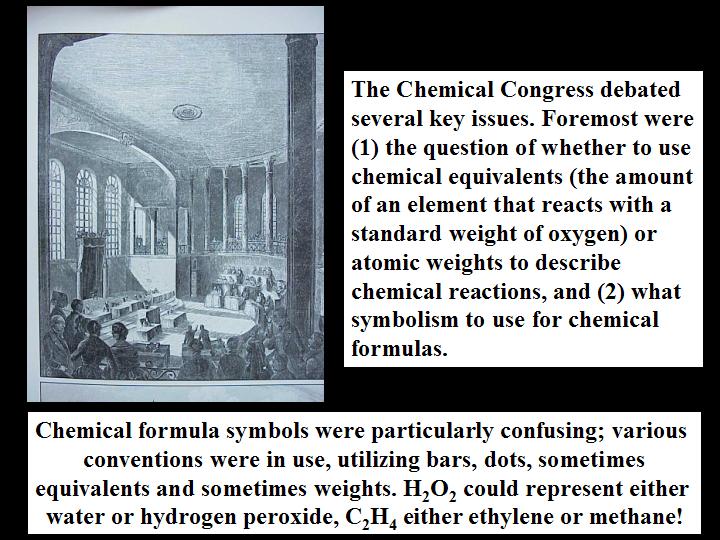
Lincoln and Karlsruhe, Germany.  Caption: The Chemical Congress of 1860 in Karlsruhe, Germany. The time had come for chemists to resolve several questions and 
to come to agreement on several conventions. 
While Lincoln was debating key issues during the
Presidential campaign in the fall of 1860, chemists
from all over the world congregated in Karlsruhe.


The Chemical Congress.  Caption: The Chemical Congress debated
several key issues. Foremost were
(1) the question of whether to use
chemical equivalents (the amount
of an element that reacts with a
standard weight of oxygen) or  
atomic weights to describe 
chemical reactions, and (2) what symbolism to use for chemical  formulas. Chemical formula symbols were particularly confusing; various 
conventions were in use, utilizing bars, dots, sometimes
equivalents and sometimes weights. H2O2 could represent either 
water or hydrogen peroxide, C2H4 either ethylene or methane!


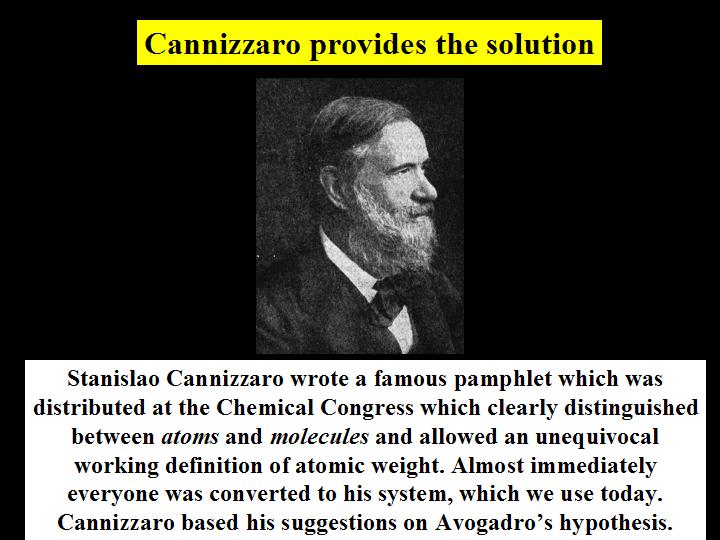
Portrait of Cannizzaro.  Caption: Cannizzaro provides the solution. Stanislao Cannizzaro wrote a famous pamphlet which was
distributed at the Chemical Congress which clearly distinguished between atoms and molecules and allowed an unequivocal working definition of atomic weight. Almost immediately
everyone was converted to his system, which we use today. Cannizzaro based his suggestions on Avogadro's hypothesis.


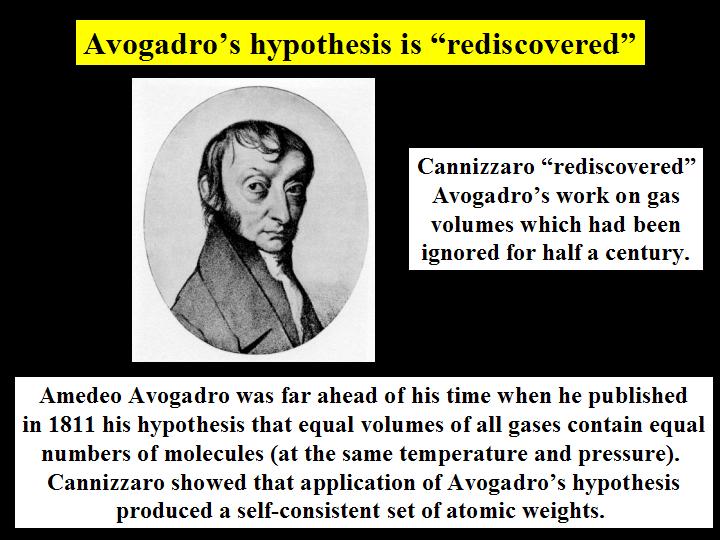
Portrait of Avogadro.  Caption: Avogadro's hypothesis is "rediscovered" Cannizzaro "rediscovered" Avogadro's work on gas volumes which had been ignored for half a century. Amedeo Avogadro was far ahead of his time when he published
in 1811 his hypothesis that equal volumes of all gases contain equal numbers of molecules (at the same temperature and pressure). Cannizzaro showed that application of Avogadro’s hypothesis produced a self-consistent set of atomic weights.


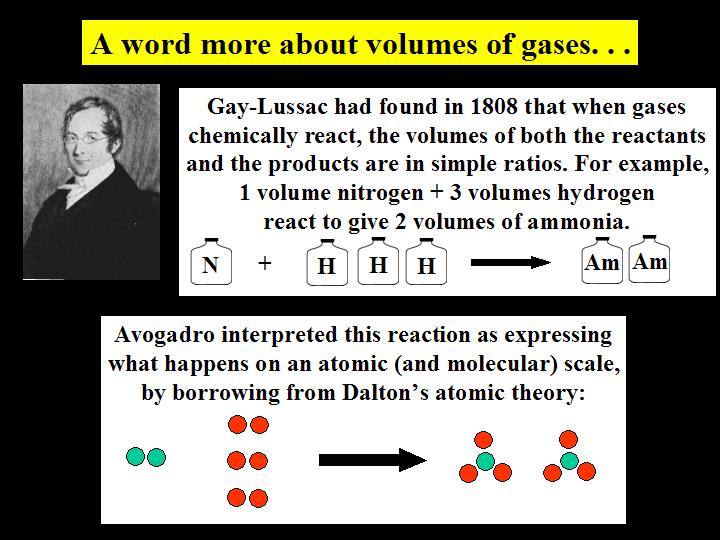
Portrait of Gay-Lussac.  Caption: A word more about volumes of gasses: Gay-Lussac had found in 1808 that when gases
chemically react, the volumes of both the reactants and the products are in simple ratios. For example, 1 volume nitrogen + 3 volumes hydrogen react to give 2 volumes of ammonia. Avogadro interpreted this reaction as expressing what happens on an atomic (and molecular) scale, by borrowing from Dalton's atomic theory.


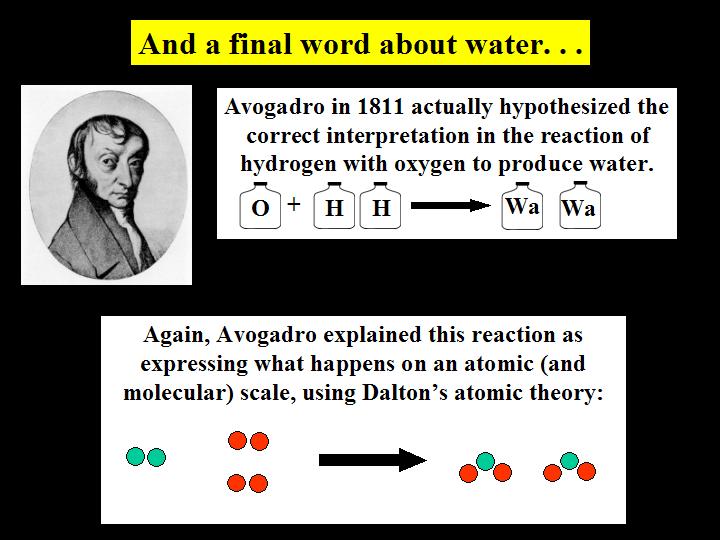
Portrait of Avogadro.  Caption: And a final word about water: Avogadro in 1811 actually hypothesized the
correct interpretation in the reaction of
hydrogen with oxygen to produce water.  Again, Avogadro explained this reaction as expressing what happens on an atomic (and molecular) scale, using Dalton’s atomic theory, 2O + 4H = 2HOH


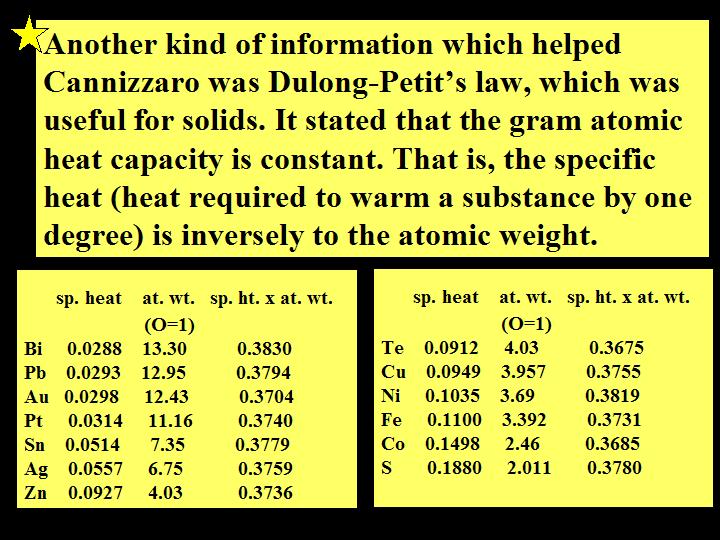
Another kind of information which helped
Cannizzaro was Dulong-Petit’s law, which was
useful for solids. It stated that the gram atomic heat capacity is constant. That is, the specific
heat (heat required to warm a substance by one degree) is inversely to the atomic weight.


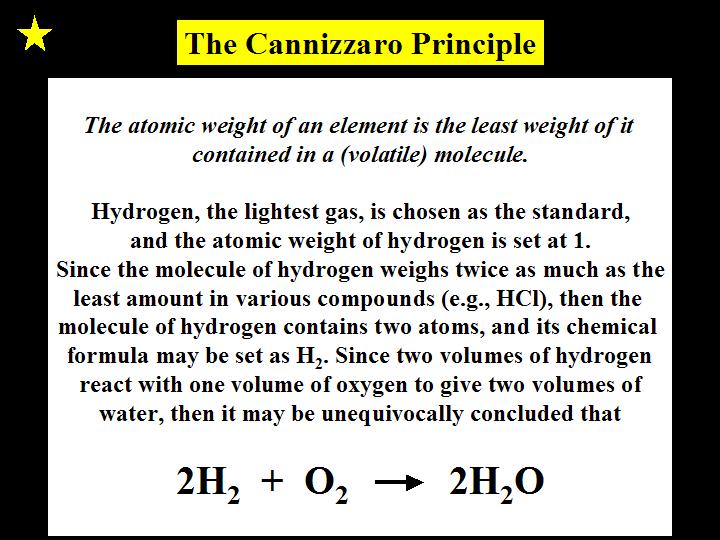
The Cannizzaro Principle: The atomic weight of an element is the least weight of it 
contained in a (volatile) molecule.

Hydrogen, the lightest gas, is chosen as the standard,
and the atomic weight of hydrogen is set at 1.
Since the molecule of hydrogen weighs twice as much as the
least amount in various compounds (e.g., HCl), then the 
molecule of hydrogen contains two atoms, and its chemical 
formula may be set as H2. Since two volumes of hydrogen
react with one volume of oxygen to give two volumes of
water, then it may be unequivocally concluded that

2H2  +  O2   =       2H2O


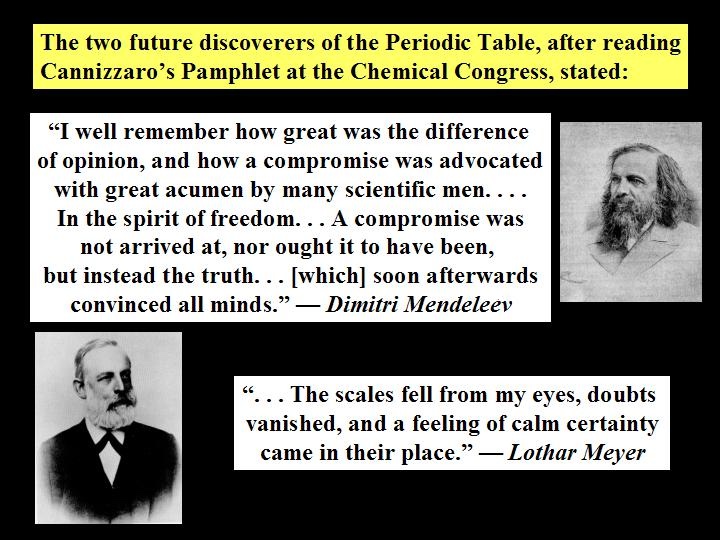
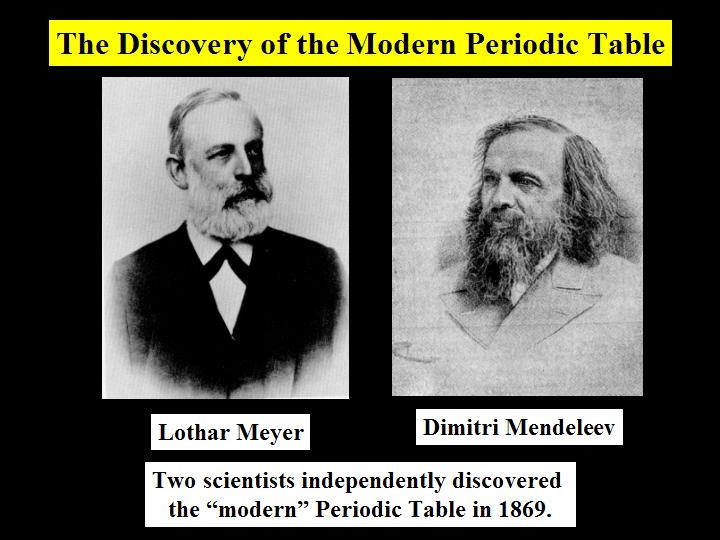
Portraits of Mendeleev and Meyer; After the Chemical Congress: 
"I well remember how great was the difference of opinion, and how a compromise was advocated with great acumen by many scientific men. . . .In the spirit of freedom. . . A compromise was not arrived at, nor ought it to have been, but instead the truth. . . [which] soon afterwards convinced all minds." — Dmitri Mendeleev
". . . The scales fell from my eyes, doubts vanished, and a feeling of calm certainty came in their place." — Lothar Meyer


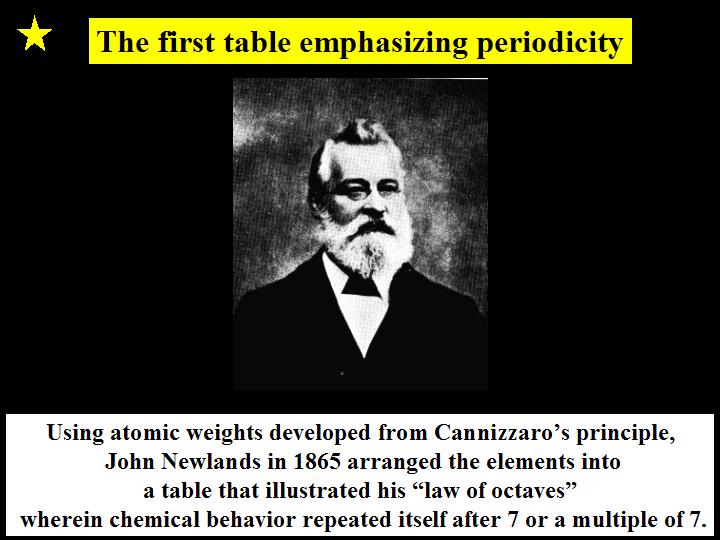
Portrait of Newlands.  Caption: The first table emphasizing periodicity: using atomic weights developed from Cannizzaro's principle, John Newlands in 1865 arranged the elements into a table that illustrated his "law of octaves," wherein chemical behavior repeated itself after 7 or a multiple of 7.


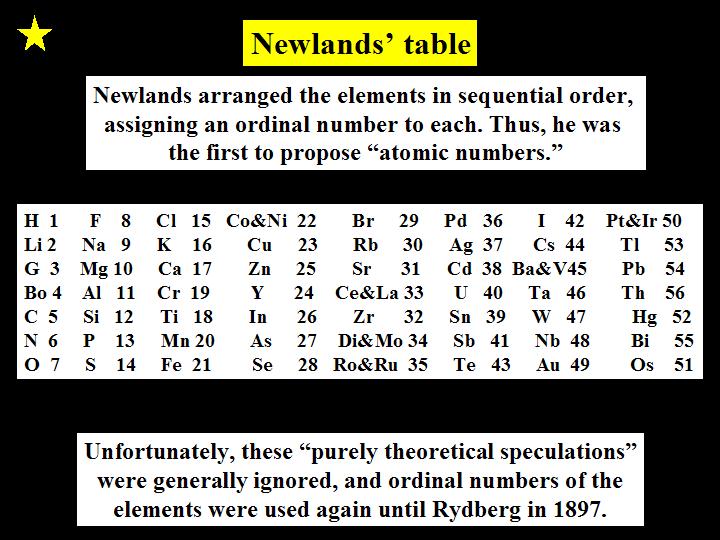
Newland's table. Newlands arranged the elements in sequential order, 
assigning an ordinal number to each. Thus, he was 
the first to propose "atomic numbers." Unfortunately, these "purely theoretical speculations"
were generally ignored, and ordinal numbers of the
elements were used again until Rydberg in 1897.


Odling's table. William Odling prepared this table in 1865 based on atomic weights, pointing out that "the sequence of properties and sequence of atomic weights are strictly parallel to one another."


Portraits of Lothar Meyer and Dimitri Mendeleev.  Caption: The Discovery of the Modern Periodic Table.   Two scientists independently discovered the modern Periodic Table in 1869.


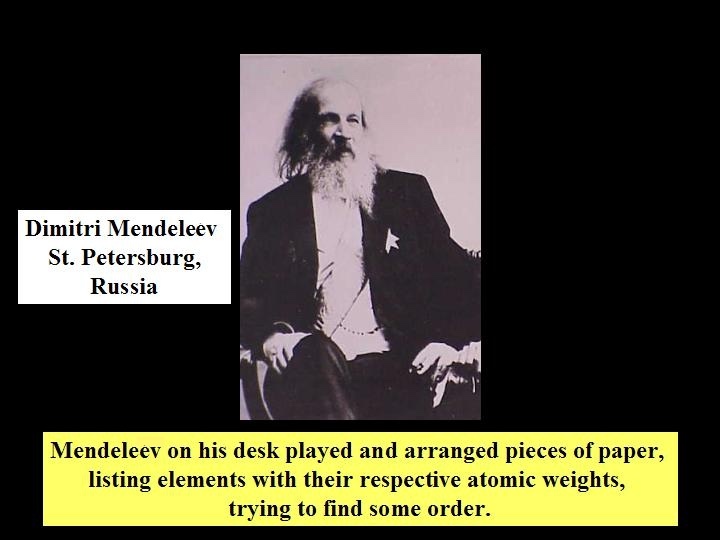
Portrait of Mendeleev.  Caption: Mendeleev on his desk played and arranged pieces of paper, listing elements with their respective atomic weights trying to find some order.


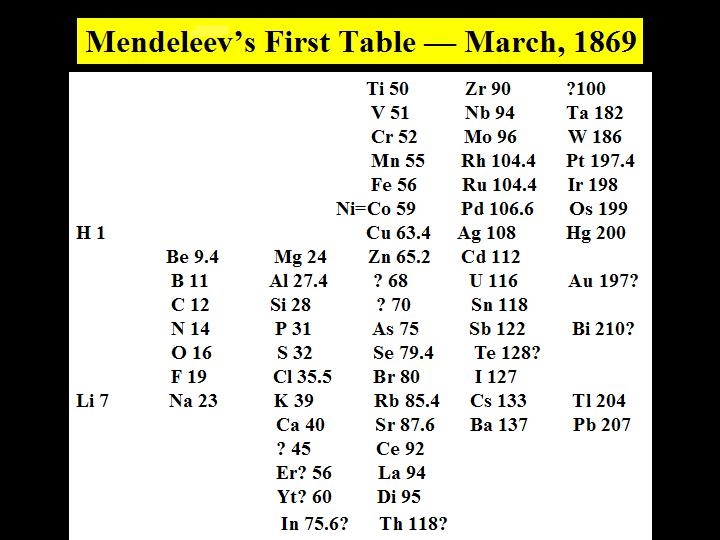
Mendeleev's first periodic table, March 1869


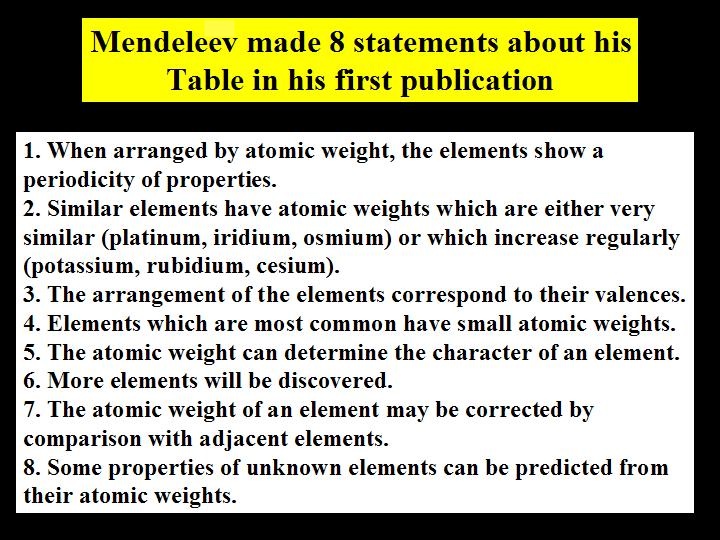
Mendeleev made 8 statements about his
Table in his first publication:
1. When arranged by atomic weight, the elements show a
periodicity of properties.
2. Similar elements have atomic weights which are either very
similar (platinum, iridium, osmium) or which increase regularly
(potassium, rubidium, cesium).
3. The arrangement of the elements correspond to their valences.
4. Elements which are most common have small atomic weights.
5. The atomic weight can determine the character of an element.
6. More elements will be discovered.
7. The atomic weight of an element may be corrected by
comparison with adjacent elements.
8. Some properties of unknown elements can be predicted from
their atomic weights.


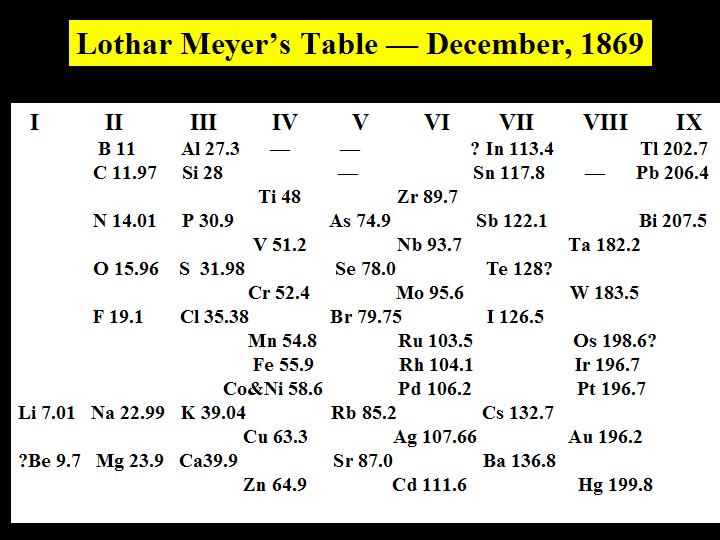
Lothar Meyer's Table, December 1869


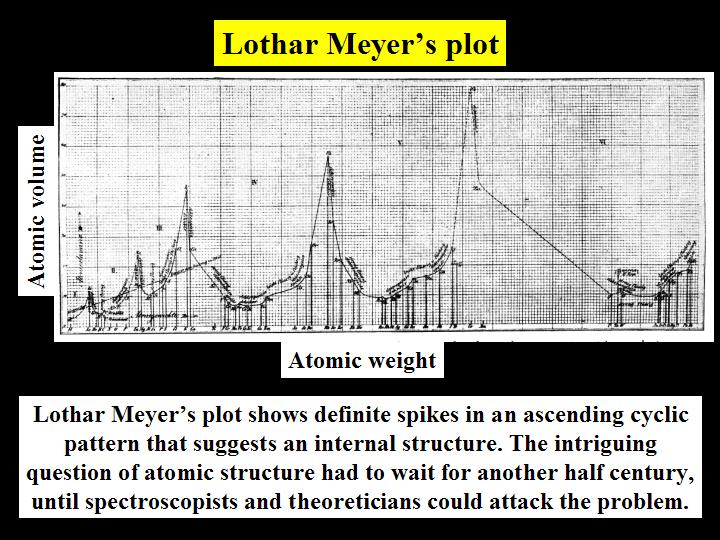
Lothar Meyer plotted atomic weight versus atomic volume and saw spikes in an ascending cyclic pattern.  Caption: Lothar Meyer's plot.  Lothar Meyer’s plot shows definite spikes in an ascending cyclic
pattern that suggests an internal structure. The intriguing
question of atomic structure had to wait for another half century,
until spectroscopists and theoreticians could attack the problem.


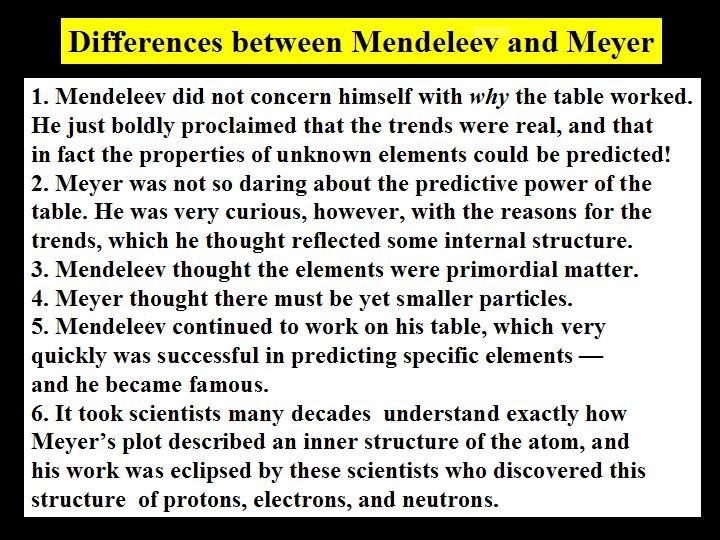
Differences between Mendeleev and Meyer: 1. Mendeleev did not concern himself with why the table worked.
He just boldly proclaimed that the trends were real, and that
in fact the properties of unknown elements could be predicted!
2. Meyer was not so daring about the predictive power of the
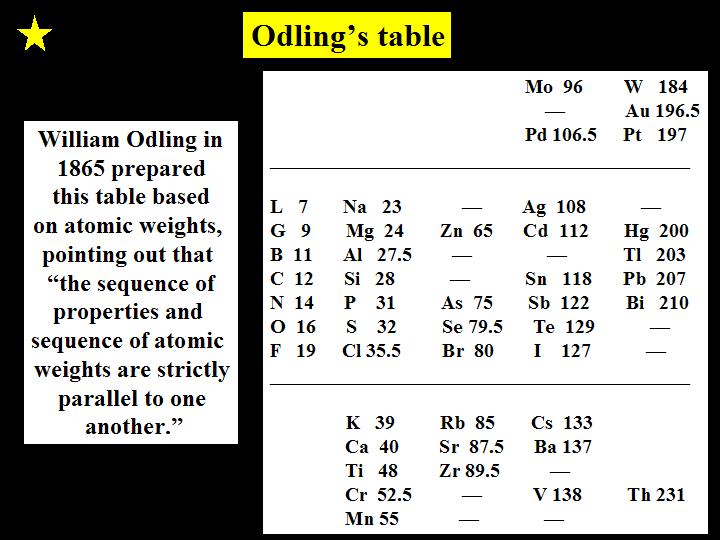
table. He was very curious, however, with the reasons for the
trends, which he thought reflected some internal structure.
3. Mendeleev thought the elements were primordial matter.
4. Meyer thought there must be yet smaller particles.
5. Mendeleev continued to work on his table, which very 
quickly was successful in predicting specific elements — 
and he became famous.
6. It took scientists many decades  understand exactly how 
Meyer's plot described an inner structure of the atom, and 
his work was eclipsed by these scientists who discovered this
structure  of protons, electrons, and neutrons.


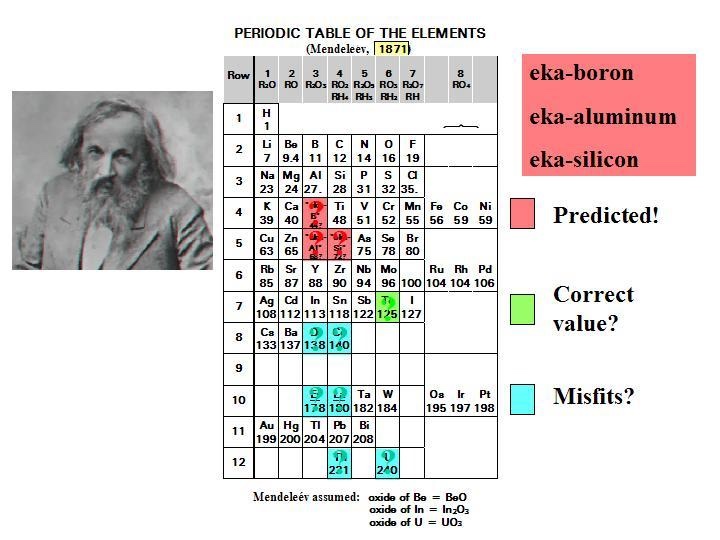
Mendeleev's Periodic Table in 1871, with unknown elements predicted: eka-boron, eka-aluminum, and eka-silicon, by the periodicity of the table and what elements were known at the time.


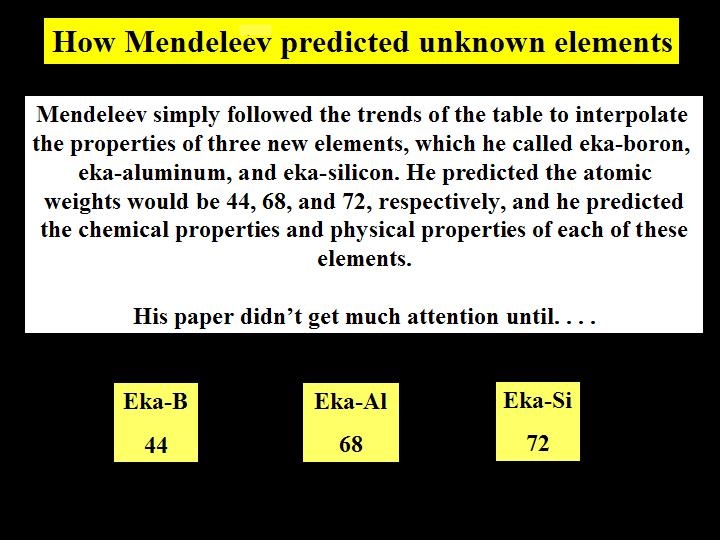
How Mendeleev predicted unknown elements.  Mendeleev simply followed the trends of the table to interpolate 
the properties of three new elements, which he called eka-boron, 
eka-aluminum, and eka-silicon. He predicted the atomic
weights would be 44, 68, and 72, respectively, and he predicted
the chemical properties and physical properties of each of these
elements.
 
His paper didn't get much attention until. . . .


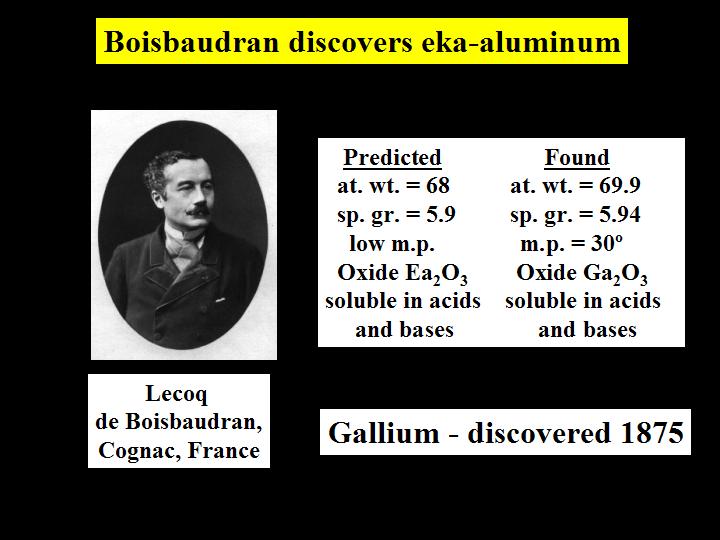
Boisbaudran discovers eka-aluminum, now known as gallium, in 1875


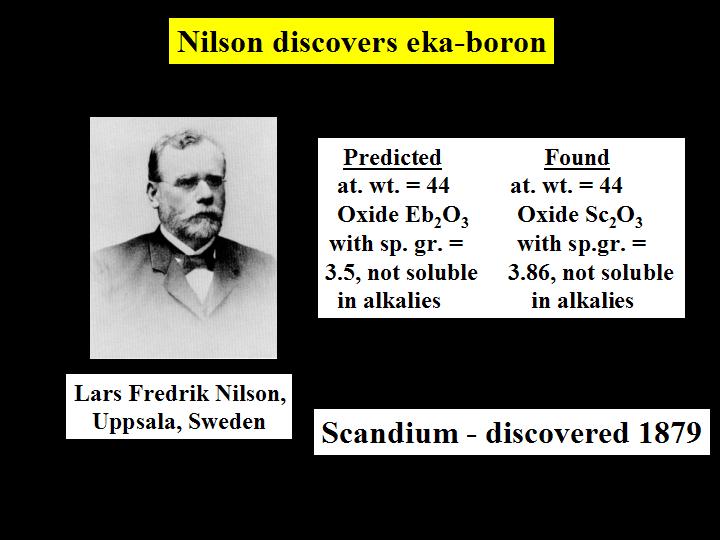
Nilson discovers eka-boron, now known as scandium, in 1879


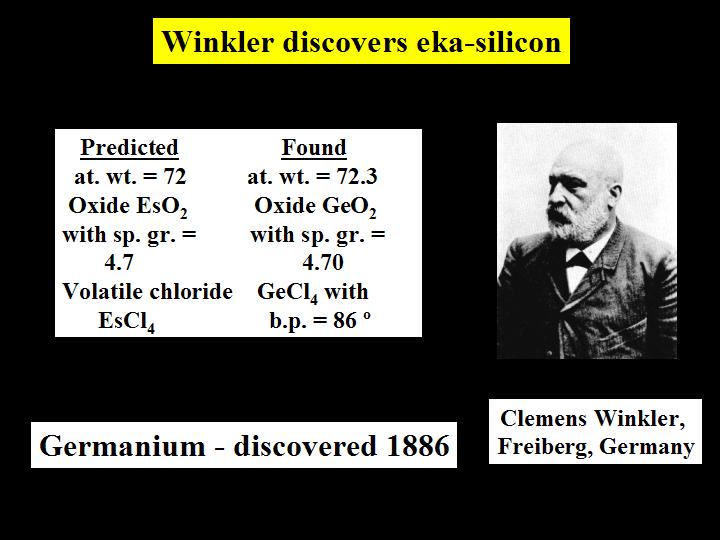
Winkler discovers eka-silicon, now known as germanium, in 1886


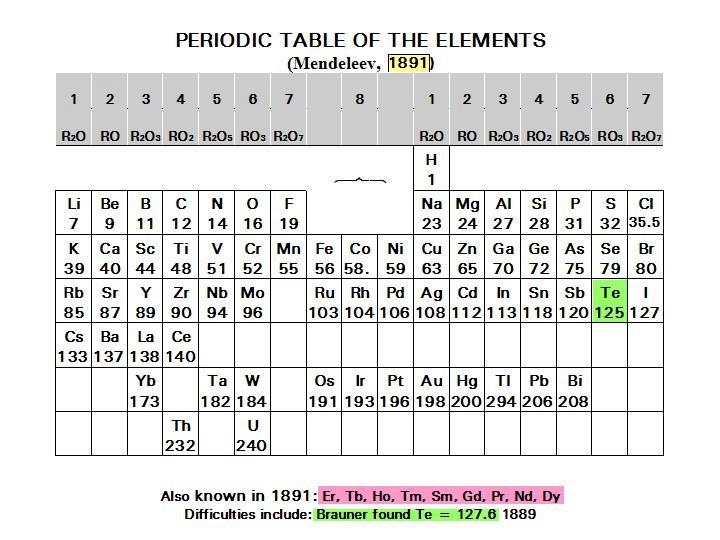
Mendeleev rewrites the periodic table of the elements in 1891 to accommodate new discoveries


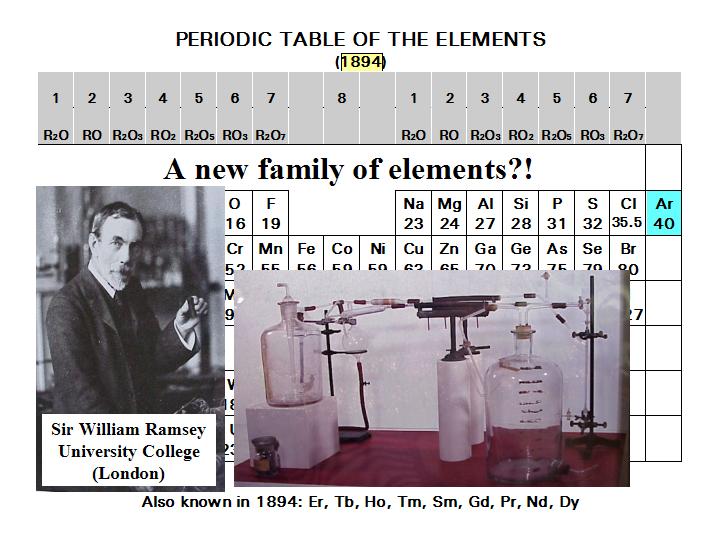
1894 Ramsey discovers the first of the noble gases, argon, and puts another column on the periodic table


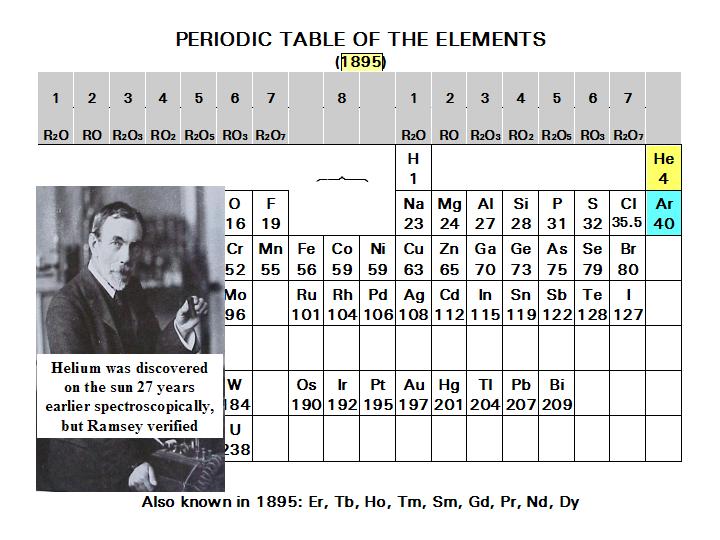
Helium was discovered on the sun spectroscopically 27 years earlier, but Ramsay verified in 1895, and puts it above argon on the periodic table


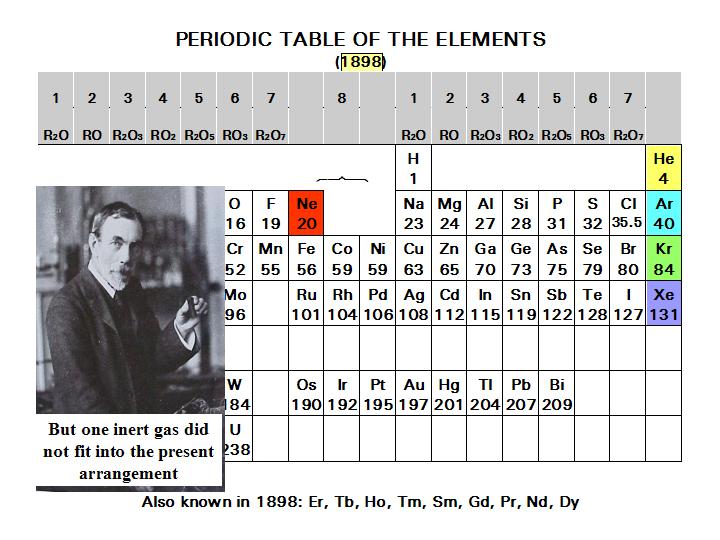
1898, krypton and xenon fall in line under argon in the noble gas column, but neon was not fitting into the table correctly!


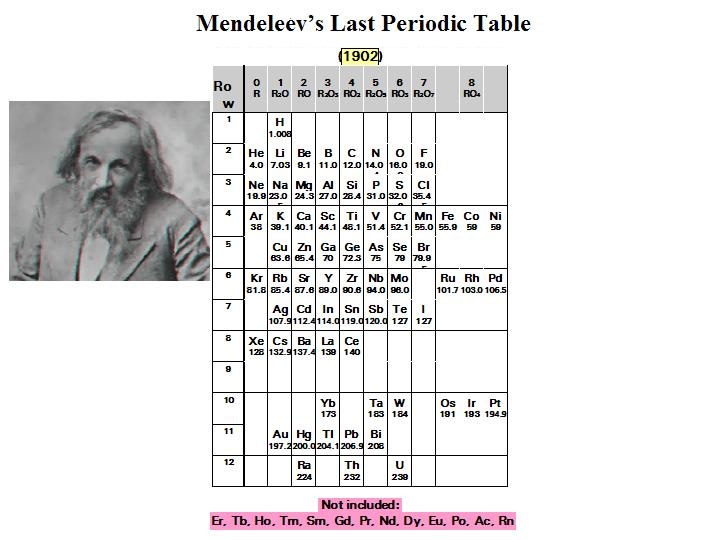
1902 Mendeleev's last periodic table, all noble gasses are moved into first column


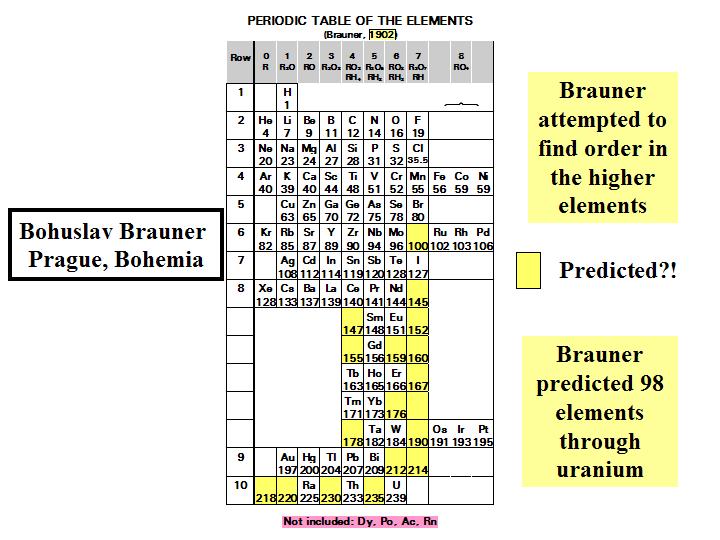
1902, Brauner used the table to predict elements 98 through uranium, based on atomic mass not atomic number


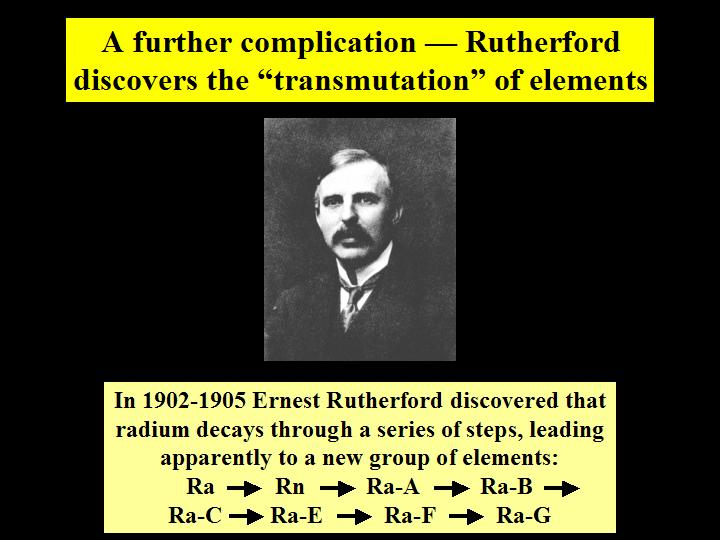
Portrait of Rutherford.  Caption: A further complication!  Rutherford discovers the "transmutation" of elements.  In 1902-1905 Rutherford determined the decay chain of radium, leading to a new group of elements.


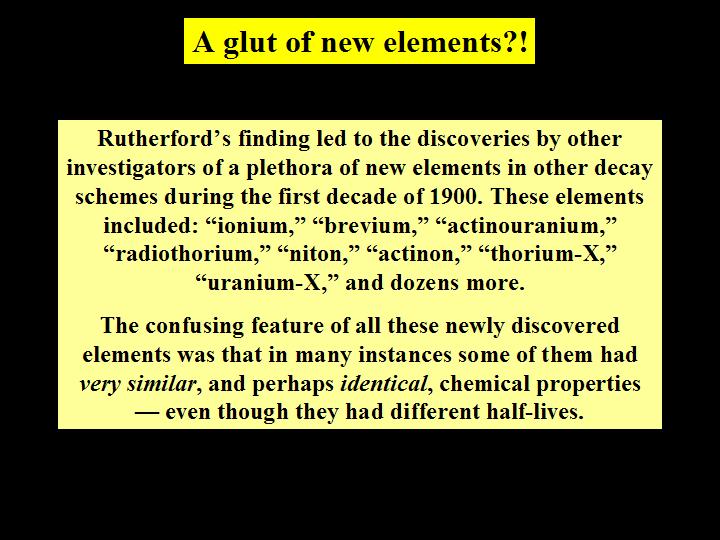
A glut of new elements?! Rutherford's finding led to the discoveries by other investigators of a plethora of new elements in other decay schemes during the first decade of 1900. These elements included: "ionium," "brevium," "actinouranium," "radiothorium," "niton," "actinon," "thorium-X," "uranium-X," and dozens more.
The confusing feature of all these newly discovered elements was that in many instances some of them had very similar, and perhaps identical, chemical properties — even though they had different half-lives.


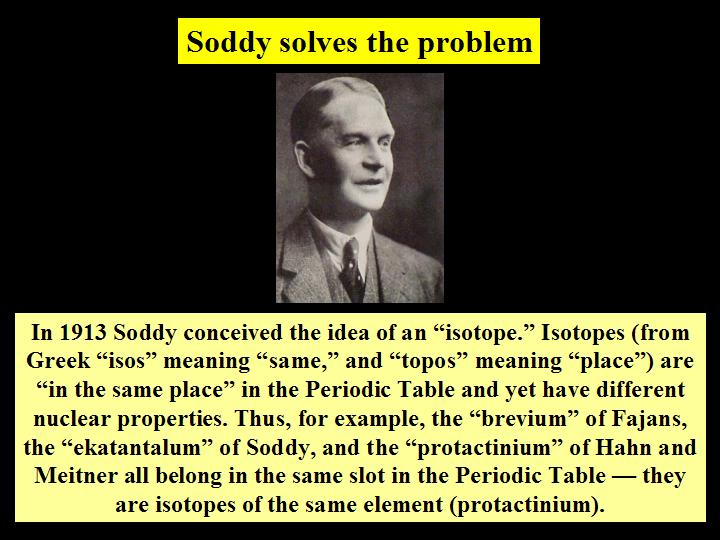
Portrait of Soddy.  Caption: Soddy solves the problem. In 1913 Soddy conceived the idea of an "isotope." Isotopes (from Greek "isos" meaning “"same," and "topos" meaning "place") are "in the same place" in the Periodic Table and yet have different nuclear properties. Thus, for example, the "brevium" of Fajans, the "ekatantalum" of Soddy, and the "protactinium" of Hahn and Meitner all belong in the same slot in the Periodic Table — they are isotopes of the same element (protactinium).


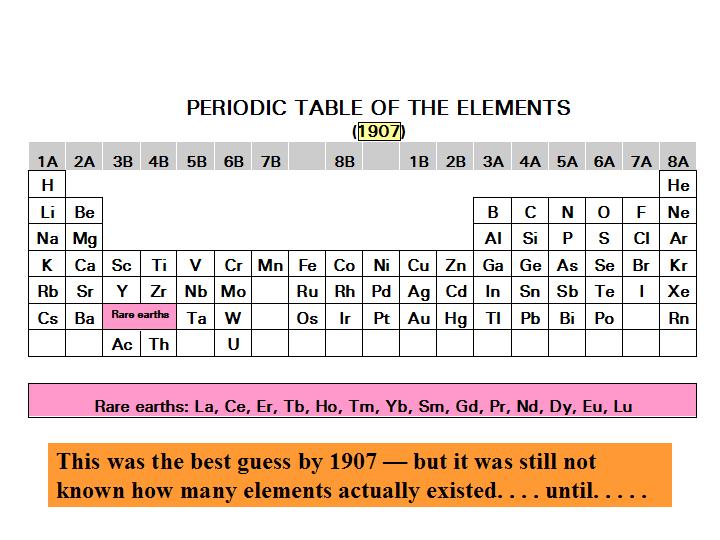
1907 periodic table looks more similar to the present day table, but still didn't know how many elements existed until...


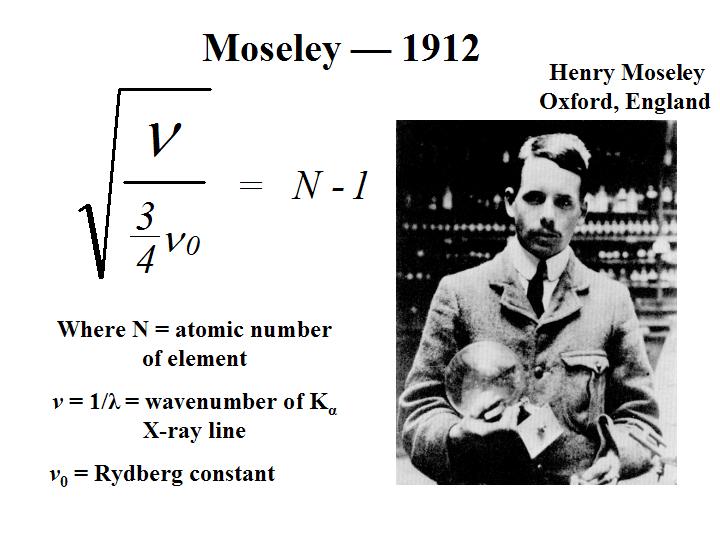
Mosley in 1912 determined Mosley's law (the square root of the frequency of characteristic X-rays emitted by an element is directly proportional to its atomic number), establishing atomic number as the basis for the periodic table


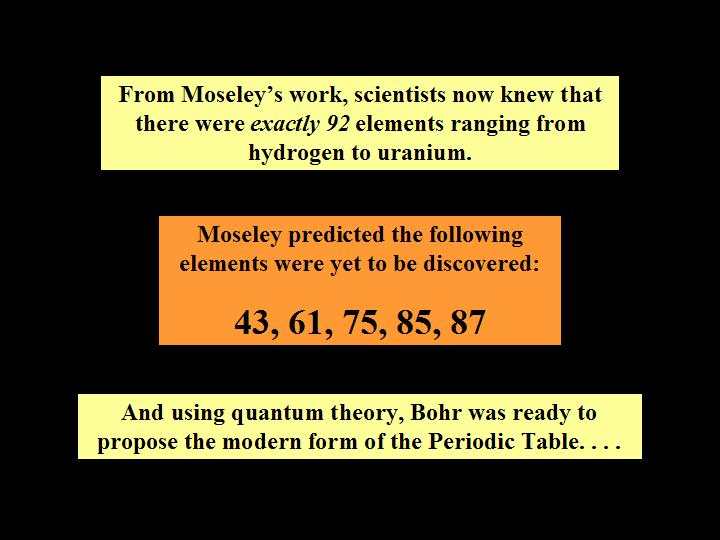
From Mosley's work, scientists now knew there were exactly 92 elements ranging from hydrogen to uranium, thus Mosley predicted elements that had not been discovered, and using quantum theory, Bohr proposed the modern periodic table.


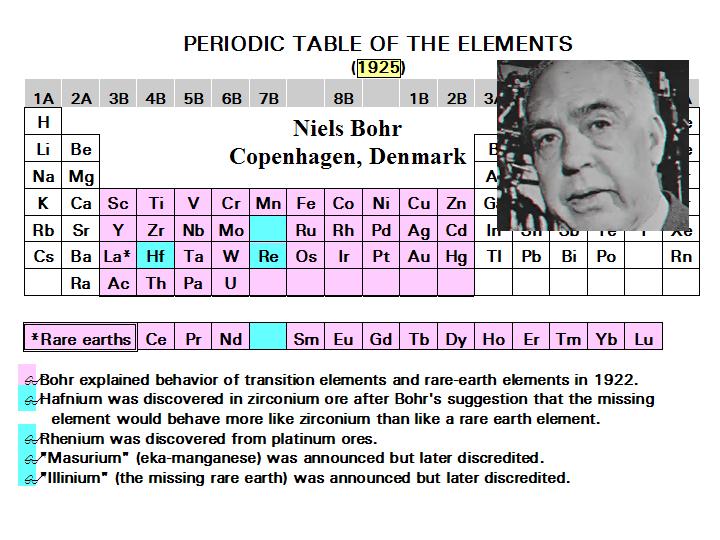
Modern periodic table 1925. Bohr explained behavior of transition elements and rare-earth elements in 1922. Hafnium was discovered in zirconium ore after Bohr's suggestion that the missing element would behave more like zirconium than like a rare earth element. Rhenium was discovered from platinum ores. Masurium (eka-manganese) was announced but later discredited. Illinium (the missing rare earth) was announced but later discredited.


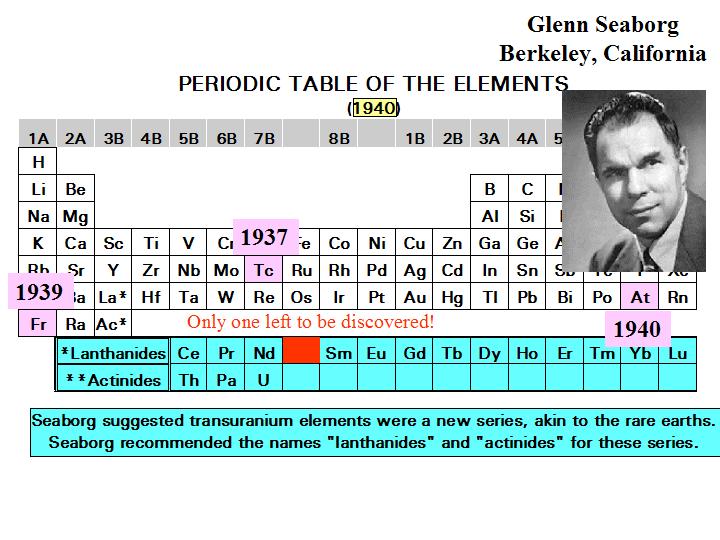
In 1940, Seaborg suggested the transuranium elements should be a new series, akin to the rare earths, naming them the lanthanides and actinides for these new series.


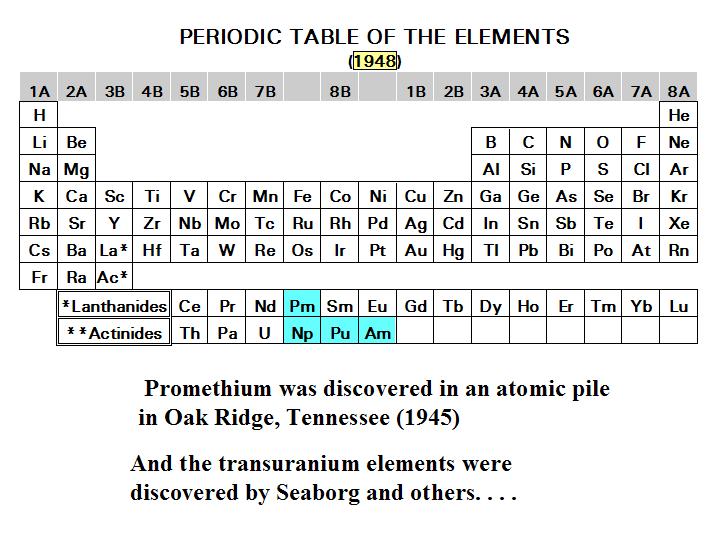
In 1945, promethium was discovered in Oak Ridge Tennessee; and Seaborg and others were discovering the transuraniums


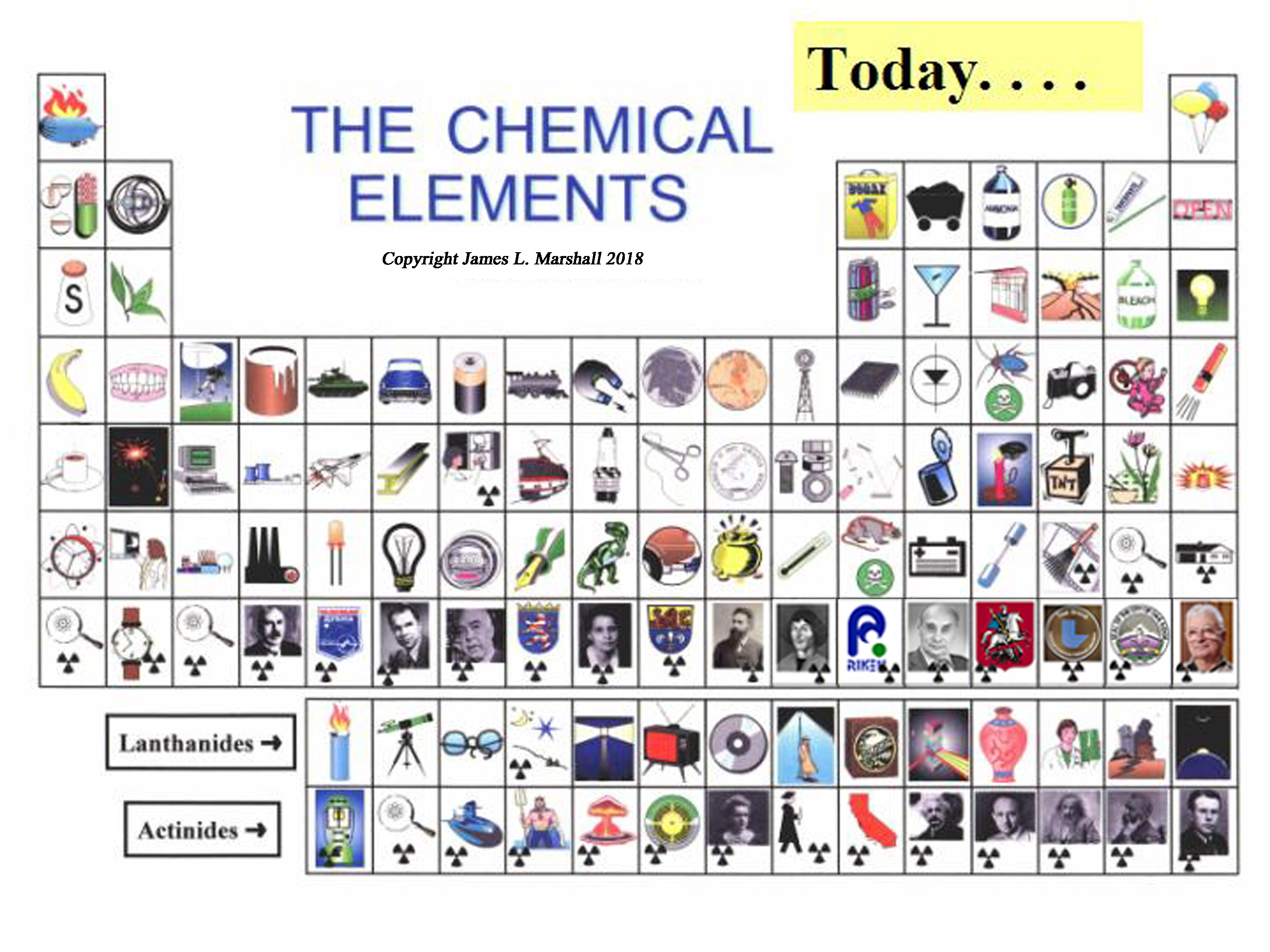
The Periodic Table today (Jim's iconic Periodic Table)


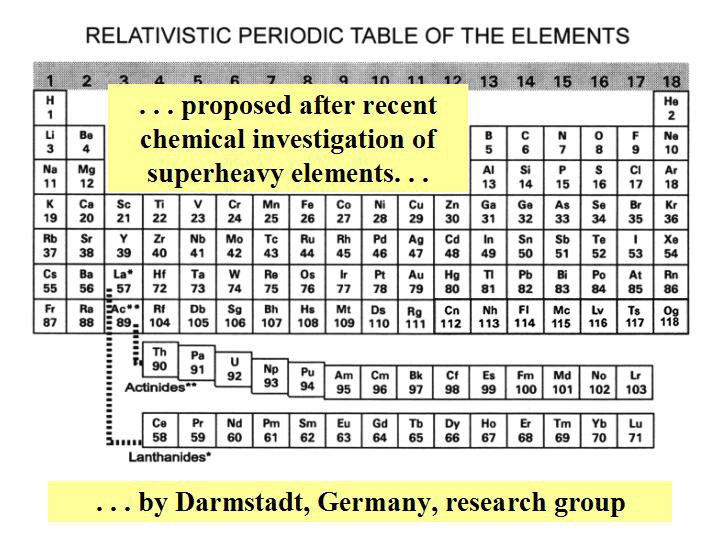
Relativistic Periodic Table, proposed after recent chemical investigations into the superheavy elements, by Darmstad, Germany research group

Back to top

Copyright ©2018 Dr. James L. Marshall and Virginia R. Marshall
All Rights Reserved.